
7 Months of YouTube Piano Tutorials — Why You’re Still Stuck
You sit down at the piano, pull up your favorite YouTube tutorial, and watch the colorful bars fall toward the keys. You pause the video, place your fingers exactly where the screen tells you, and play the notes. Then you rewind, watch the next three seconds, and repeat the process.
It has been seven months since you started this journey. At first, it felt like magic. You were playing recognizable melodies within days, bypassing the tedious years of traditional lessons. But lately, that initial excitement has been replaced by a heavy, familiar frustration.

When you try to tackle harder pieces, the sheer volume of falling notes becomes an overwhelming blur. If you make a single mistake or lose your place, the entire song falls apart because you do not actually know the music—you only know the sequence of finger movements. You are left wondering: Do I just need to be more patient and play slower? Or is it finally time to surrender and learn how to read sheet music?
The truth is, you are not alone in this struggle. Thousands of adult beginners hit this exact wall between six and twelve months into their self-taught journey. The problem is not your patience, your talent, or your age. The problem is that you have been taught to mimic, not to play.
The Illusion of Progress
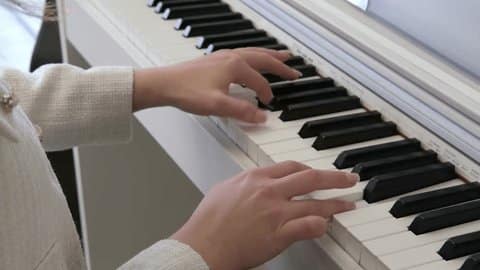
YouTube tutorials, particularly those using Synthesia or “put your finger here” methods, are incredibly seductive. They offer immediate gratification. However, they rely entirely on visual mimicry. You are essentially playing a game of Simon Says with your keyboard.
While this method can help you memorize the physical choreography of a simple song, it completely bypasses the fundamental skills required to actually understand music. You are building muscle memory without musical comprehension.
When a piece becomes complex—introducing intricate rhythms, wide leaps, or dense chords—the mimicry method breaks down. Your brain simply cannot process and memorize that many isolated, disconnected visual cues. This is why you feel stuck. You have built a house on a foundation of sand, and as the structure gets heavier, it begins to collapse.
The False Dichotomy: Slower Mimicry vs. Sheet Music
Faced with this plateau, most adult beginners believe they only have two options. The first option is to double down on the tutorials, slowing the playback speed to 0.5x and painfully grinding through the piece measure by measure. This approach requires immense willpower and often leads to burnout.
The second option is to pivot entirely and learn to read sheet music. While reading music is a valuable skill, it is notoriously difficult for adults to pick up quickly. It often feels like learning a new language from scratch, pulling you away from the joy of actually making music and plunging you into months of dry, academic study.
But what if there was a third option? What if the secret to breaking through this plateau was not about training your eyes to read faster or your fingers to move quicker, but about training your ears to understand?
The By-Ear Method: Building Real Musical Skills

The reason you feel lost when you make a mistake is that you lack a mental map of the song. You are navigating a complex city by memorizing a list of left and right turns. If you miss one turn, you are completely lost.
Playing by ear changes this dynamic entirely. Instead of memorizing isolated finger movements, you learn to recognize the underlying structure of the music. You begin to hear the relationships between notes, the pull of different chords, and the predictable patterns that make up almost every song you want to play.
When you understand the music by ear, you are no longer a passenger blindly following directions; you are the driver with a GPS. If you take a wrong turn, you know exactly how to navigate back to the main road because you understand the landscape.
Developing Your Musical GPS
Transitioning from visual mimicry to playing by ear involves shifting your focus from the screen to the sound. It requires you to actively listen to the music you want to play and identify its core components.
First, you learn to find the melody—the part of the song you can hum. By training your ear to recognize the distance between notes (intervals), you can pick out melodies on the keyboard without needing a tutorial to show you the way.
Next, you uncover the harmony. Most popular songs are built on a foundation of predictable chord progressions. Once you learn to hear these common patterns, you can accompany your melodies with rich, full-sounding chords.
This approach builds genuine musical skills. It allows you to learn songs faster, retain them longer, and even improvise or change the key of a song to suit your mood. You transition from being a typist copying a manuscript to a storyteller speaking your own language.
Your Next Step: Stop Watching, Start Listening
If you are tired of feeling confused by complex tutorials and frustrated by your lack of real progress, it is time to change your approach. You do not need to spend the next year struggling through beginner sheet music, and you certainly do not need to spend hours pausing and rewinding YouTube videos.
You need a method that builds real skills, a method that gives you a map of the music rather than a list of instructions.
To help you make this transition, I have put together a comprehensive resource designed specifically for adult beginners who are stuck in the tutorial trap.
This free guide will show you exactly how to break down any song by ear, understand its structure, and play it confidently without relying on a screen or a sheet of paper. It is time to stop mimicking and start playing. Grab your copy of the GPS Map today and discover the freedom of true musical understanding.
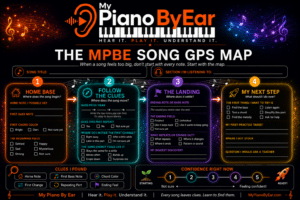
✓ Instant access to The MPBE Song GPS Map
Why You’re Struggling After 7 Months of Piano Tutorials – Manus