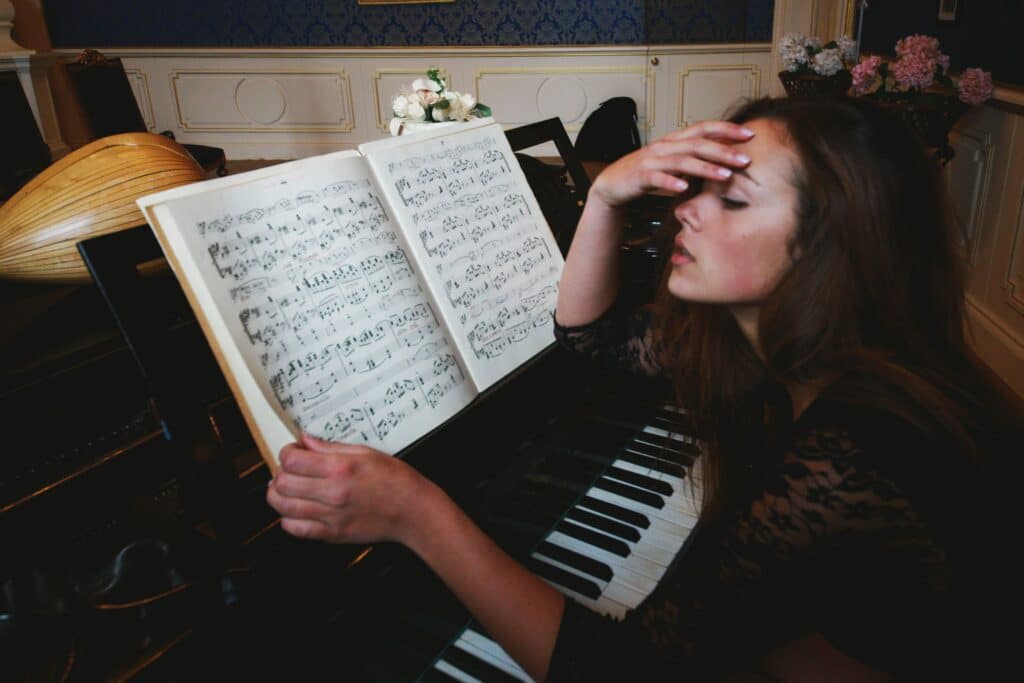
She sat down at the bench fifteen minutes early, like she always did. Sheet music squared up, hands resting in her lap, trying to look calm. Then the door opened and a twelve-year-old walked in, plopped down at the other keyboard, and ripped through a piece she'd been chipping away at for three weeks — without even looking at the page.
Nobody said anything. Nobody had to. She packed up her bag a little faster than usual that day. By the time she got to her car, she'd already decided: she was done. The keyboard could go on Facebook Marketplace. The lessons could go too.
If that story sounds uncomfortably familiar, you're not alone — and you're not the problem.
It Was Never About Talent
Here's the truth nobody tells you when you sign up for adult piano lessons: most studios were never built with adults in mind. The curriculum, the pacing, the group classes — all of it was designed around how kids learn, then handed to grown-ups with a shrug and a "this should work fine."
It doesn't work fine. It humiliates people.
You walk in as a beginner and get placed next to someone who's been playing since before they could tie their shoes. You're handed the same theory-heavy method books written for eight-year-olds with unlimited afternoons to practice. You're expected to sight-read in front of an audience before you've even built confidence finding middle C.
None of that is a fair test of whether you can play piano. It's a test of whether you can survive being compared to people who started decades before you did, in a system that was never designed to protect your dignity while you learn.
The Real Reasons Adults Quit (Hint: It's Not Talent)
After watching adult beginners walk away from piano over and over, the pattern becomes obvious. It's rarely about ability. It's about the environment.
You got grouped with kids half your age. Nobody warns you that "beginner lessons" often means sharing a room with a nine-year-old who's already fluent. That's not a fair comparison — it never was.
You were buried in theory before you played a single recognizable song. Key signatures. Time signatures. Circle of fifths. By the time most adults play something that actually sounds like music, they've already quietly decided they're "not musical."
The pace was set by someone else. Adult life doesn't run on a metronome. Miss one week for work or family, and suddenly you're "behind" — in a hobby that was supposed to relieve stress, not add to it.
Every lesson felt like a performance review. A teacher hovering while you sight-read live, in real time, is anxiety — not learning. Adults need room to fumble privately before they're ready to be watched.
There was no one else like you in the room. No other adults starting from zero at 35, 45, or 65. Just you, feeling like the odd one out in your own hobby.
Add it up, and quitting doesn't look like a failure of willpower. It looks like a completely reasonable response to a system that was quietly humiliating you the whole time.
What Adult Beginners Actually Need
Adults don't need a watered-down version of a children's curriculum. They need an entirely different starting point — one built around how grown adults actually learn best.
That means learning by ear before getting buried in notation. It means playing real, recognizable songs in the first few sessions instead of months into a method book. It means practicing privately, at your own pace, without an audience judging every wrong note in real time.
Most of all, it means being surrounded by people who get it — other adults who also started late, who also feel a little embarrassed at first, who also just want to sit down and play something that sounds good without a kid in the next room making it look effortless.
A Judgment-Free Way Back to the Keys
If you've still got that keyboard sitting in the corner — or you sold it and have regretted it ever since — this isn't a sign you should give up on piano. It's a sign you were taught the wrong way the first time.
You don't need a recital. You don't need a twelve-year-old prodigy two seats away. You need a place built specifically for adults relearning piano on their own terms, at their own pace, without an ounce of judgment.
That's exactly what we're building. Start with the free beginner course here, or comment PIANO on our latest post and we'll send you the link to join the community directly.